

Sprints
A sprint is a stretch of time, usually two weeks, with a goal and a set of issues you plan to finish. You plan it, start it, work through it and complete it, deciding what happens to anything left over.
One sprint for all teams
Section titled “One sprint for all teams”In XLR8, sprints don’t belong to a team. This is a deliberate choice. As one person you have one stream of time, however many teams your work is spread across. Sprints per team split that time into parallel plans that nobody keeps up, so XLR8 plans it once: a sprint holds issues from any team, and at most one sprint runs at a time.
For the same reason nothing rolls over silently. When you complete a sprint, every unfinished issue needs a decision, so the same issues don’t drift from sprint to sprint unnoticed.
The life of a sprint
Section titled “The life of a sprint”A sprint is in one of three states:
- Planning: you pick issues and set a goal and capacity. Nothing is running yet.
- Active: you started it. Issues added from now on count as added late.
- Closed: you completed it. Its contents are frozen as a record of what happened.
A sprint never starts or ends on its own when its dates arrive. Both are deliberate steps. You can plan the next sprint while the current one is still running.
Plan a sprint
Section titled “Plan a sprint”- Choose Plan sprint in the command menu (CtrlCommand K), or click Plan sprint in the sprint view (G then S).
- If no sprint is in planning yet, fill in Create sprint: Name, Start, End and an optional Goal. By default a sprint runs two weeks, starting the day after the current sprint ends, or next Monday if no sprint is open.
- On the planning page, move issues from the Backlog column on the left into the sprint on the right.
- Set a Capacity and check the planned points against it.
- Click Start sprint when you’re ready.
If you start a sprint before its planned start date, it starts today and keeps its length, so its end moves forward too. If you complete a sprint before its planned end, its end date becomes today.
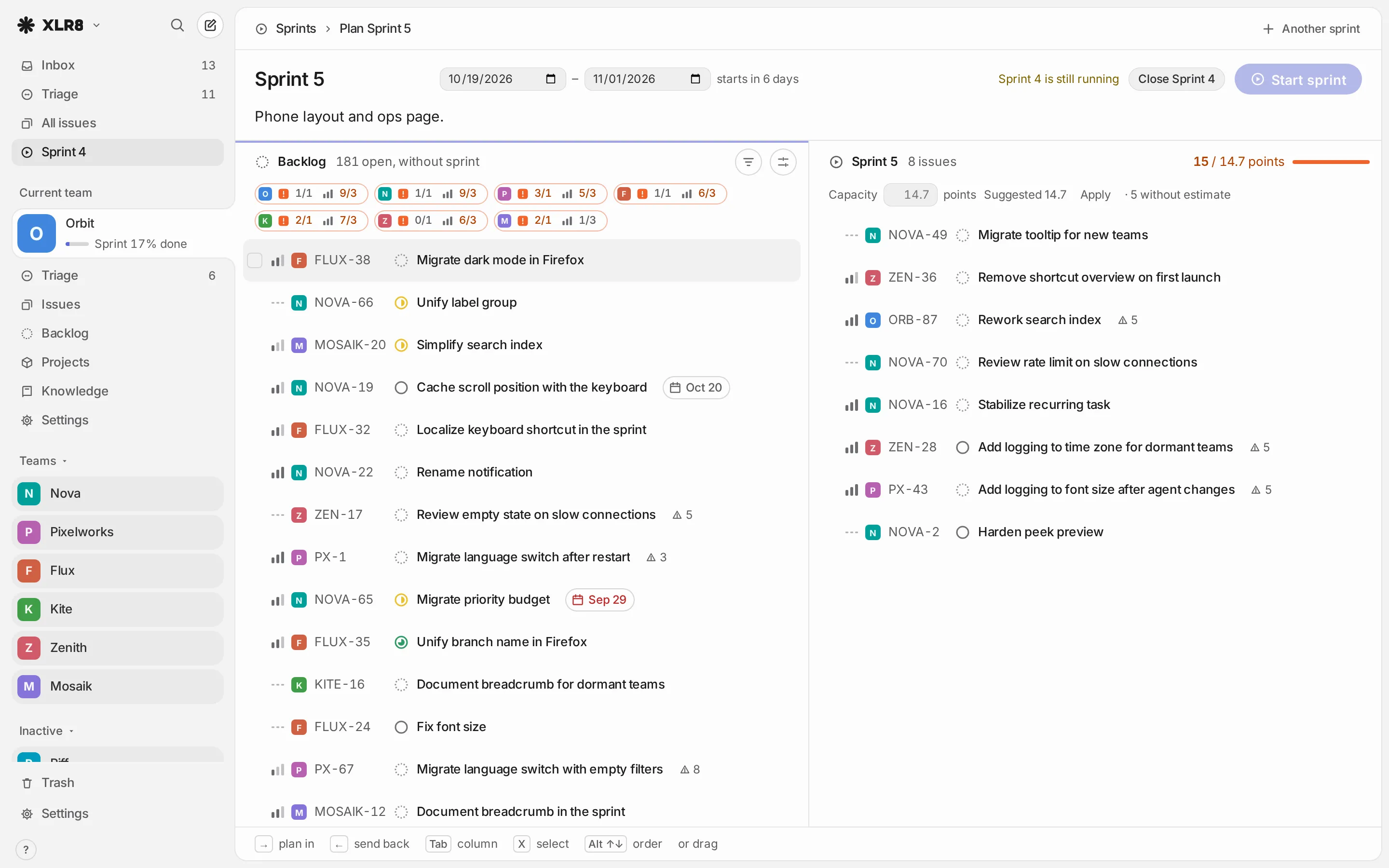
The Backlog column shows open, accepted issues without a sprint from all active teams. Triage issues, dormant teams and knowledge-only teams are left out. Filters and display options work as in any list.
| Key | Action |
|---|---|
| Right arrow | Move the focused or selected issues into the sprint |
| Left arrow | Send them back to the backlog |
| Tab | Switch between the two columns |
| X | Select |
| AltOption Up arrow or AltOption Down arrow | Change the order |
You can also drag issues between the columns.
Capacity and the priority budget
Section titled “Capacity and the priority budget”Capacity is the number of points you expect to finish. XLR8 suggests one: the average of points completed in your last three sprints. Click Apply to take it, or type your own. The sprint column shows planned points against capacity, warns when you plan more than fits, and counts issues without estimate, because those add nothing to the total.
Above the backlog, a strip shows each team’s open Urgent and High issues against the priority budget (1 Urgent, 3 High).
During the sprint
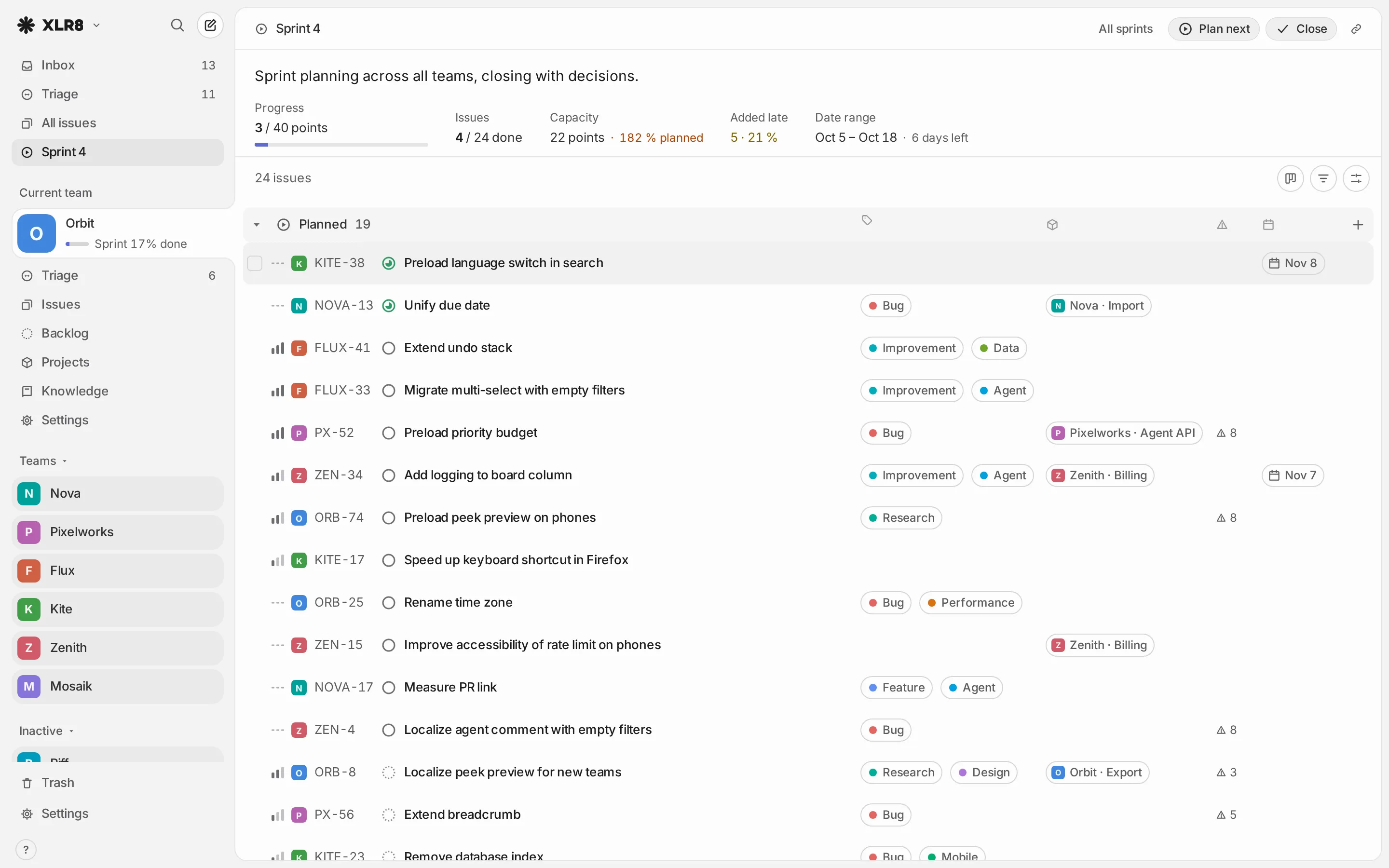
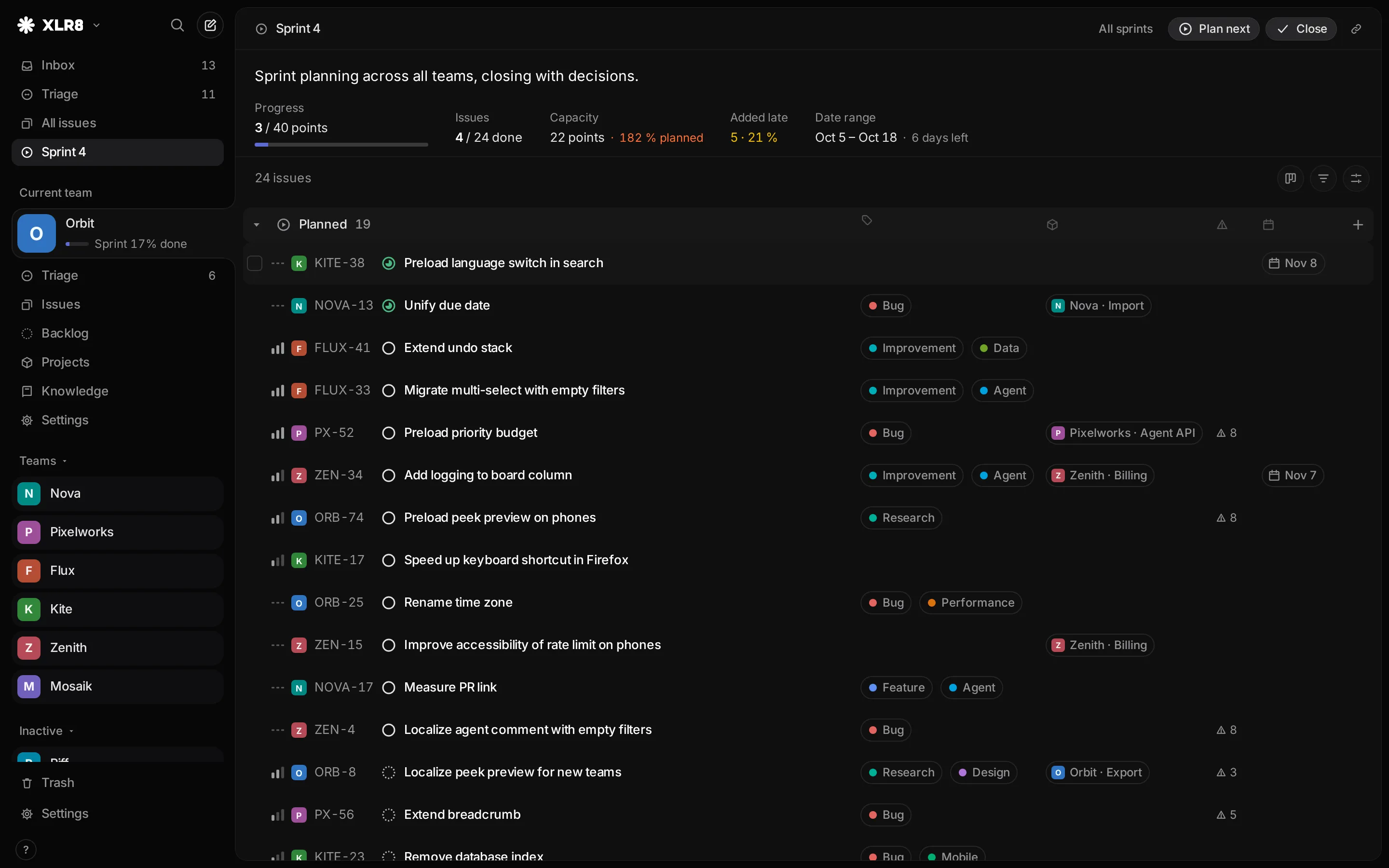
Section titled “During the sprint”Press G then S (Go to: Sprint) to open the running sprint. The header shows the goal, Progress in points, how many Issues are done, the Capacity with the share planned, how many issues were Added late, and the Date range with the days remaining. By default the list is grouped into Planned and Added later, then by status.
To put issues into a sprint from anywhere:
- Shift C (Sprint …) opens the sprint picker: the running sprint, sprints in planning, or No sprint.
- Add to the sprint in the command menu adds the selection to the running sprint, or, if none runs, to the sprint in planning.
- A new issue created in the sprint view goes into the sprint.
Complete a sprint
Section titled “Complete a sprint”Choose Complete sprint in the command menu, or Close in the sprint view. The completion page lists every issue that is not done yet.
- Done issues count as completed automatically. Canceled and duplicate issues are recorded as canceled.
- Every other issue needs a decision:
| Key | Decision | What happens |
|---|---|---|
| 1 | Next sprint | Carried over into the sprint chosen under Carry over to: a sprint in planning or a New sprint (will be created) |
| 2 | Backlog | Leaves the sprint; its status stays |
| 3 | Cancel | Leaves the sprint and gets the status Canceled |
| 0 or BackspaceDelete | Clear decision |
Select several issues to decide for all of them at once. Add a short retrospective if you like, then click Close with the sprint’s name, or press CtrlCommand Enter, once every issue has a decision. Nothing is moved without your decision.
Past sprints
Section titled “Past sprints”All sprints in the sprint view (or Go to: All sprints in the command menu) lists every sprint with its goal, date range, points done against planned, how much was added late and how many issues were carried over. Cycles imported from Linear appear here as well.
A closed sprint keeps its record: which issues were planned or added late, what happened to each, and the estimate each completed issue had at that moment. Reopening an issue or changing its estimate later does not change that record or the capacity suggestion.